Inherent risk methodology
How VendorSoluce™ scores vendor exposure before controls — so you can explain to auditors and leadership why one vendor is Critical and another is Low.

What you need to know
- What it is: This method scores the vendor relationship from observable facts (access, criticality, blast radius)—not from marketing claims.
- Why inherent risk first: Inherent risk is exposure before controls. It decides how deep the review goes; residual risk (after controls) comes later.
- What you get: A defensible Critical / High / Medium / Low tier you can show to leadership and auditors.
What this methodology is
Vendor Inherent Risk Assessment is the methodology behind VendorSoluce™ inherent scoring. It scores the relationship from observable facts — not vendor marketing — and yields a tier: Critical, High, Medium, or Low. It is not a security audit; it sets how much diligence you owe before and during residual-risk work.
Why inherent risk must be assessed first
This method sets the baseline before vendor engagement. Tier reflects structural facts your org defines — data, criticality, access, regulation — so effort and questionnaires scale to real exposure.
- Defensibility — Tiers map to stated inputs (e.g. record volume + production access + DPA).
- Proportionality — Light process for Low; full diligence path for Critical.
- Independence — SOC 2 / ISO do not raise inherent tier; they inform residual risk later.
- Consistency — Same rules across new, legacy, and renewal relationships.
The five domains of inherent risk
Five domains (0–100 each), weighted and combined per NIST SP 800-161 C-SCRM guidance.
The scoring formula
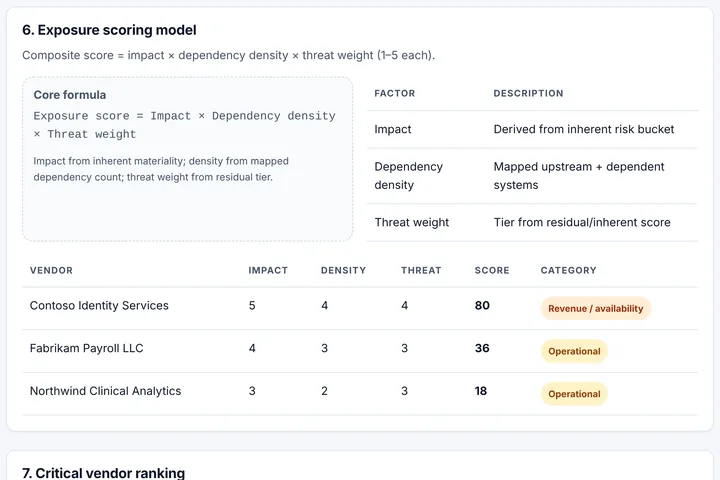
Domains score 0–100 from discrete inputs; weighted sum yields a raw score; overrides may raise the minimum tier.
Capped at 100 per domain. Factors are weighted and summed, then capped. Discrete inputs only — no interpolation — so every point traces to an observed characteristic.
Non-negotiable overrides
Four conditions set a floor tier so a low average cannot hide one catastrophic factor. Evaluated after the weighted score; elevate only if below the minimum.
| Condition | Rationale | Minimum tier |
|---|---|---|
| Tier 1 sensitive data processing (Health, Biometric, Children's data) |
Elevated legal and reputational impact for health, biometric, or children’s data. | High |
| Privileged or admin system access | Admin or privileged access implies lateral movement if the vendor is compromised. | High |
| Sole provider of a mission-critical function (no documented alternative) |
No practical substitute for a mission-critical sole provider. | High |
| Regulated processing requiring a BAA (HIPAA Business Associate Agreement) |
PHI under HIPAA requires a BAA and baseline diligence regardless of vendor claims. | Medium |
The four risk tiers
Four tiers drive minimum diligence depth before approval.
Required due diligence by tier
Minimum diligence is prescribed by tier (not by vendor size or contract value).
The assessment process
Owned by your risk or procurement team, before vendor questionnaires or evidence.
Inherent vs. residual risk
Inherent scoring stops at inherent tier; residual work follows.
| Factor | Inherent risk | Residual risk (after controls) |
|---|---|---|
| Who determines it | Your org from observed facts | Questionnaires, certifications, verified evidence |
| Vendor certifications | Not in scope for inherent score | Core inputs in diligence |
| Security questionnaire | Not used beforehand | Depth follows tier |
| When it changes | Relationship change (data, integration, scope) | Control posture change (certs, findings, incidents) |
| Can vendor improve it? | No | Yes |
| Audit defensibility | Auditable to discrete inputs | Depends on evidence quality |
Standards alignment
Domains and weighting align to common TPRM references; primary anchors are NIST C-SCRM and CSF.
| Standard | Role in this method |
|---|---|
| NIST SP 800-161 Rev 1 (C-SCRM) | Primary — inherent vs residual, criticality, assess before supplier engagement; maps to D2/D5. |
| NIST CSF 2.0 | Primary — Identify / Govern and third-party risk context. |
| ISO/IEC 27036 | Supporting — supplier assessment before engagement; documented criteria. |
| GDPR Art. 28 | Regulatory — processor guarantees and DPA surface in D4. |
Map first, then run a full assessment
Free tools on this site use the same inherent-risk tiers. Full assessments (structured diligence + evidence) run in the Workspace.
